Sales Pipelines, the StoryBrand Way
It All Begins Here
How a Properly Built Pipeline Creates Predictable Revenue, Without the Guesswork
You didn't start your business to spend Monday mornings wondering where the next client is coming from.
But here we are.
Leads go quiet. Follow-up gets messy. A deal you were sure was closing just... doesn't. And revenue swings up and down in a way that makes planning feel pointless. You're working hard; nobody could accuse you of not working hard, but the results don't reflect that effort. Not consistently, anyway.
Here's what I've learned after working with enough business owners to know the pattern well: this isn't a hustle problem. It's not a confidence problem. It's a system problem. And system problems can be solved.
The fix I keep coming back to, the one that creates the most visible, lasting change for my clients and myself, is a properly built sales pipeline. The phrase sounds more complicated than it is. Let me show you what it actually means, how it works, and why pairing it with clear StoryBrand messaging turns it into something that genuinely runs on its own.
What a Sales Pipeline Actually Is
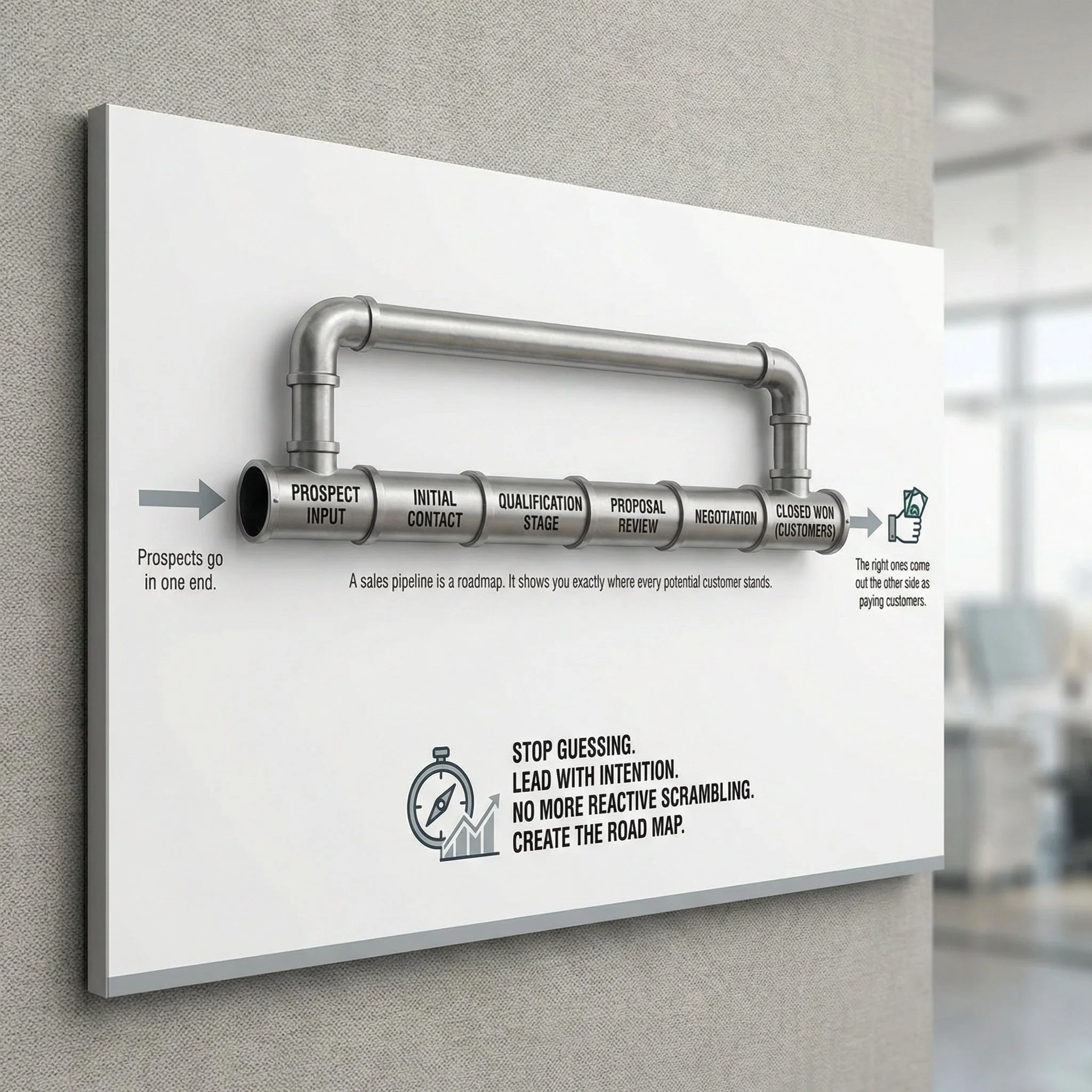
A sales pipeline is a roadmap. It shows you exactly where every potential customer stands, from the moment they first hear your name to the moment they hand you money, and everything that comes after.
Think of it like a literal pipe. Prospects go in one end. They move through clearly defined stages. The right ones come out the other side as paying customers. When those stages are in place, you stop guessing what to do next. You stop letting warm leads go cold because life got busy. You start leading people forward with intention.
No more reactive scrambling. No more revenue surprises. Just a clear picture of what's happening and what needs to happen next.
The Seven Stages, Told as a Story
Here's what most sales training misses: pipeline stages aren't just business jargon. They map directly onto a human story.
Your customer is the hero (not you). They have a problem. You are the guide. The pipeline is the path you walk together. That's it. That's the whole framework.
Let me make it concrete. Say you sell lemonade. Your customer is thirsty. Your job is to guide them from curious to confident, one clear step at a time.
1. Prospecting: You identify who might actually want what you offer. Not everyone. The right people. Neighbors, referrals, people who already love what you do.
2. Lead Qualification: You confirm they want lemonade and can buy it. Not everyone is the right fit, and that's not failure; that's clarity. Qualifying saves your time and protects your energy.
3. Conversation, You talk. You ask real questions. You listen more than you pitch. This is where trust gets built, and trust is what moves people forward.
4. Proposal: You make a clear, simple offer. What they get, what it costs, what happens next. No mystery, no friction, no buried fine print.
5. Negotiation, If there are remaining questions about timing, price, or scope, you address them honestly, not as a pushy salesperson closing a deal, but as a trusted guide helping someone make a good decision.
6. Closing: They buy. You get paid. They become a customer.
7. Follow-Up: You check in. You make sure they're happy. You invite them back, ask for a referral, a review, or introduce the natural next step. A transaction becomes a relationship. By the way, one of the biggest mistakes we can make is adopting a transactional mindset rather than a relationship mindset. So often, I see a “grab the money and go” approach, with no follow-up to that customer. Consider the value of nurturing an existing customer versus the cost of acquiring a new one.
Why a Pipeline Gives You Back Control
The real power of a pipeline isn't organization for its own sake. It's visibility.
When every deal lives in your head, scattered across texts and inboxes and sticky notes, you can't manage it. You can't improve what you can't see.
A pipeline change where you know where every opportunity stands. You choose the right next action at the right time. You can forecast revenue with something resembling confidence. And when deals stall, you can see where they're stalling, which means you can fix the actual bottleneck instead of just working harder into the void.
The Part Most People Miss: Marketing Keeps the Pipeline Full
Donald Miller makes a point in How to Grow Your Small Business that I return to again and again with clients. Marketing isn't a nice extra. It's the system that keeps bringing the right people to your door.
A pipeline with no marketing feeding it is just a very organized empty pipe.
Here's how StoryBrand thinking fills the top of your pipeline and makes every stage easier once people are in it.
Start by clarifying your message. If your message is confusing, people hesitate. And hesitation kills pipelines. Your marketing should answer four questions instantly: What do you offer? Who is it for? What problem does it solve? What does success look like for your customer?
A formula I use with clients sounds like this: After putting this framework in place, business owners get a clear sales system and consistent revenue, so they can build a business that actually feels like freedom, without the guesswork, the stress, or the feast-and-famine cycle.
When your message is that clear, the right leads identify themselves. Qualification gets easier before a single conversation happens.
Build a lead generator that starts relationships. A lead generator is a free, genuinely useful resource that solves one small problem and earns you permission to follow up. For my clients, that might be a simple pipeline-tracking template, a checklist for defining their stages, or a short guide to the five numbers every business owner should watch each week. This is how you create prospecting momentum without hunting for it.
Use a nurture sequence to move leads forward. Most people aren't ready to buy the first time they find you. That's normal. A short email sequence builds trust over time. A simple five-email flow might look like this:
• Email 1: Name the problem clearly and explain why it matters
• Email 2: Walk through the pipeline stages as a simple, reassuring plan
• Email 3: Teach one useful metric or tool they can apply immediately
• Email 4: Share a real outcome story from someone who's been where they are
• Email 5: Give a clear call to action: book a call, download something, reply with a question
Make your next step obvious. StoryBrand teaches that customers need an invitation. Your marketing should always tell people exactly what to do next. When that call to action is vague or buried, your pipeline starves, and you wonder why good leads aren't converting.
The Numbers That Tell You If Your Pipeline Is Healthy
You don't need a dashboard full of metrics. You need a small set of simple numbers, reviewed consistently.
Watch these: total active deals, deals by stage, number of qualified leads coming in each week, win rate, customer acquisition cost, and average time a deal sits in each stage before moving.
These numbers tell you where your process is working and where your messaging or follow-up needs attention. They replace gut feelings, which are unreliable, with actual information you can act on.
Pipeline vs. Funnel: Same Journey, Different Lens
You'll hear both terms. Here's the quick distinction, because it matters.
A sales funnel focuses on volume and conversion. How many people move from one step to the next? This is marketing thinking; it helps you understand whether enough of the right people are entering the pipeline.
A sales pipeline focuses on actions and stages. What do you do next to move a specific deal forward? This is sales thinking; it's about execution, follow-through, and relationships.
You need both. Funnel thinking improves your messaging and marketing volume. Pipeline thinking improves your follow-through and conversion. Together, they give you the full picture.
Build Your Pipeline This Week: A Simple Plan
You don't need a perfect system. You need a working one.
1. Pick one place to track your prospects. A CRM, a spreadsheet, a whiteboard, something you'll actually open. Don't let perfect be the enemy of functional.
2. Define your stages based on how you actually sell. Not how a textbook says you should sell. How do you sell to your clients in your industry?
3. Assign one clear CTA (call to action) to each stage. Send the follow-up email. Schedule the call. Send the proposal. One action. Make it obvious.
4. Set basic weekly targets. New leads, conversations started, proposals sent. Simple numbers you can track. (see The Numbers That Tell You If Your Pipeline Is Healthy above)
5. Review it every single week. Move deals forward. Clear out what's stuck. Improve one weak spot at a time.
That's it. That's the whole system at its core.
The Bottom Line
A sales pipeline is just an organized way to guide people from interested to invested. When you combine a clear message, consistent marketing that keeps generating leads, and a simple pipeline you actually review each week, you stop hoping for revenue and start building it.
That's what predictable growth looks like. Not magic. Not hustle. A clear message, a simple system, and the discipline to work it every week.
If you're ready to build yours, I'd love to help. Tell me what you sell and who you serve, and we'll build a pipeline and a message that fits your actual business, not someone else's template.
Start with a free business growth assessment [here]. Then schedule a no-pressure 45-minute clarity call, and you'll leave with a customized plan to move your business forward. Not a generic framework. A real next steps plan for what you're building.
Here’s to your success!
All The Best,
Mac